What happens when you give students a real-world problem, access to expert mentors, and the freedom to think beyond the classroom?
You don’t get a school project, you get a healthcare innovation.
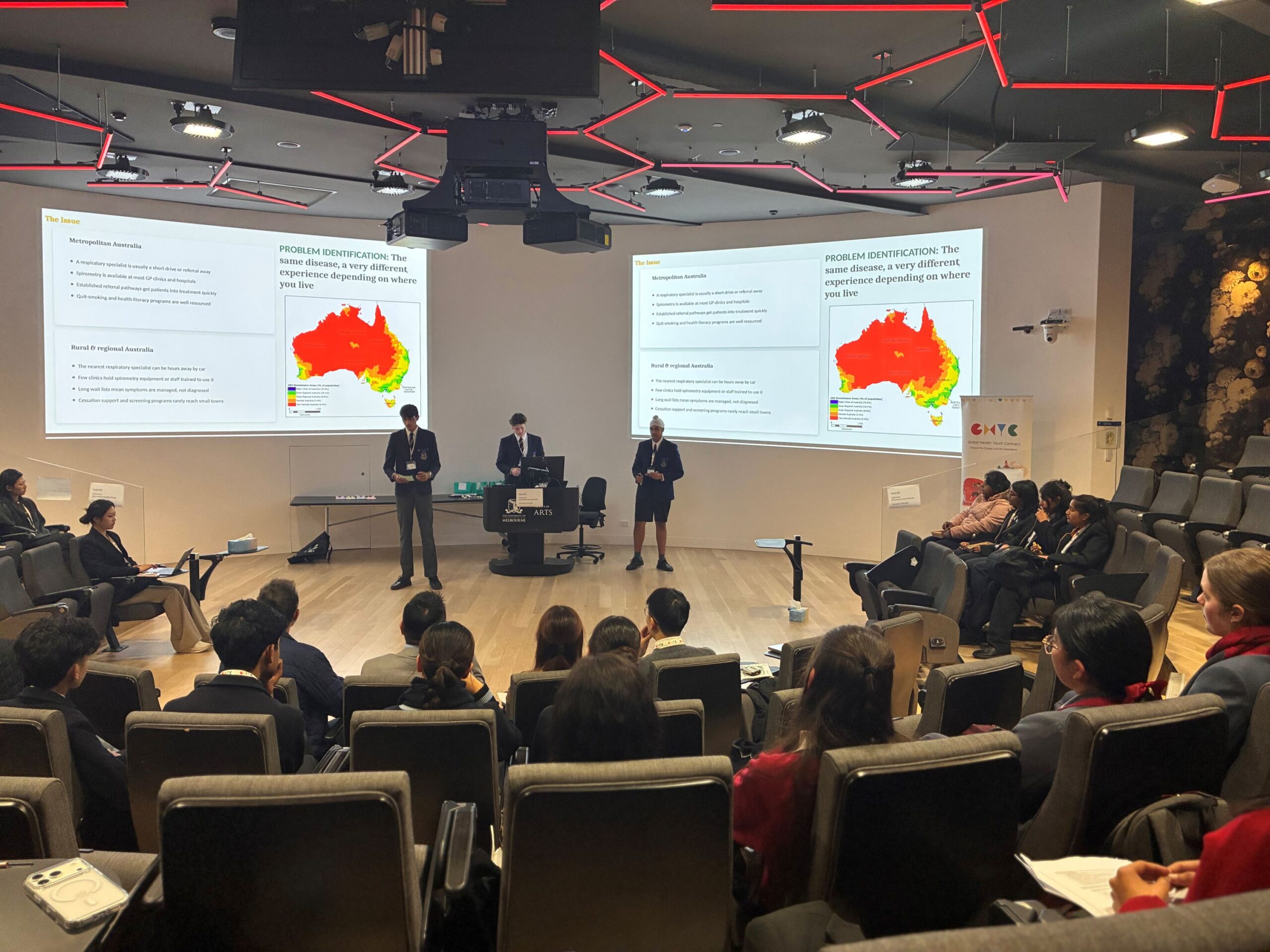
Year 10 students Lukas, Jordan and Divnit recently took on the Global Health Youth Connect (GHYC) Case Competition, a prestigious student-led initiative affiliated with the University of Melbourne’s Faculty of Medicine, Dentistry and Health Sciences. Competing against approximately 50 teams from more than 35 schools across Victoria, they were challenged to solve a problem impacting thousands of Australians: Chronic Obstructive Pulmonary Disease (COPD).
This wasn’t a competition about memorising facts or finding the “right” answer. It was about tackling a complex healthcare issue with the same mindset used by researchers, policymakers, entrepreneurs and medical professionals.
The challenge asked students to rethink how Australians, particularly those in rural and regional communities, access diagnosis, treatment and ongoing care for COPD. In response, Lukas, Jordan and Divnit developed B.R.E.A.T.H.E. (Bridging Rural and Equitable Access to Healthcare, Education and Early-detection), an ambitious and practical healthcare model designed to bring specialist support closer to the people who need it most.
Their proposal combined mobile respiratory screening vans, telehealth consultations, digital patient support tools and community education programs into one integrated system. But what made their solution stand out was not just the idea itself, it was the depth of thinking behind it.
The team immersed themselves in medical research, public health policy, economics, government funding models, technology design and data analysis. They investigated existing healthcare systems, explored potential partnerships with organisations such as the Royal Flying Doctor Service and Lung Foundation Australia, and mapped out a realistic implementation strategy complete with budgets, stakeholder engagement plans, risk assessments and sustainability measures.
In other words, they didn’t just imagine a better future, they designed one.
Their work earned them a place among the Top 10 teams in Victoria, an outstanding achievement given the calibre of schools involved. As finalists, they were paired with University of Melbourne medical student mentors who helped refine their proposal and prepare them for the final presentation round.
Standing before a panel of healthcare professionals, respiratory specialists, consultants and university representatives, the students delivered a professional pitch before defending their proposal through detailed questioning on feasibility, funding, workforce challenges and long-term impact.
It was the kind of experience more commonly associated with startup accelerators, university research programs or government innovation forums than secondary school.
Their solution ultimately placed 5th in Victoria, a remarkable result that reflects not only academic excellence, but also curiosity, resilience and a willingness to engage with challenges that have no easy answers.
At TKS, learning isn’t confined to what happens inside a classroom. Increasingly, students are stepping into authentic, future-focused experiences where they are asked to think critically, collaborate across disciplines and create solutions for real problems.
The success of Lukas, Jordan and Divnit demonstrates exactly what can happen when young people are empowered to lead their own learning. They weren’t simply studying healthcare. They were helping to reimagine it.
And in a world that needs new ideas more than ever, that’s a powerful place to start.