What can a piece of Blu Tack teach us about one of the great thinkers of the ancient world? Quite a lot, as our Year 6 students discovered this term.
Year 6 students have been exploring the fascinating connections between Science, Mathematics and Humanities, investigating how influential individuals and their discoveries have shaped the world we live in today.
In Humanities, the History unit ‘Groups and Individuals Who Have Changed the World in a Positive Way’ has encouraged students to look beyond the present and explore the people, events and ideas that have influenced societies throughout history. Through historical inquiry, students have considered the challenges faced by significant changemakers, the discoveries they made and the lasting impact of their work.
One of those influential figures is Archimedes, the ancient Greek mathematician, scientist and inventor whose work helped deepen our understanding of water displacement, volume and buoyancy.
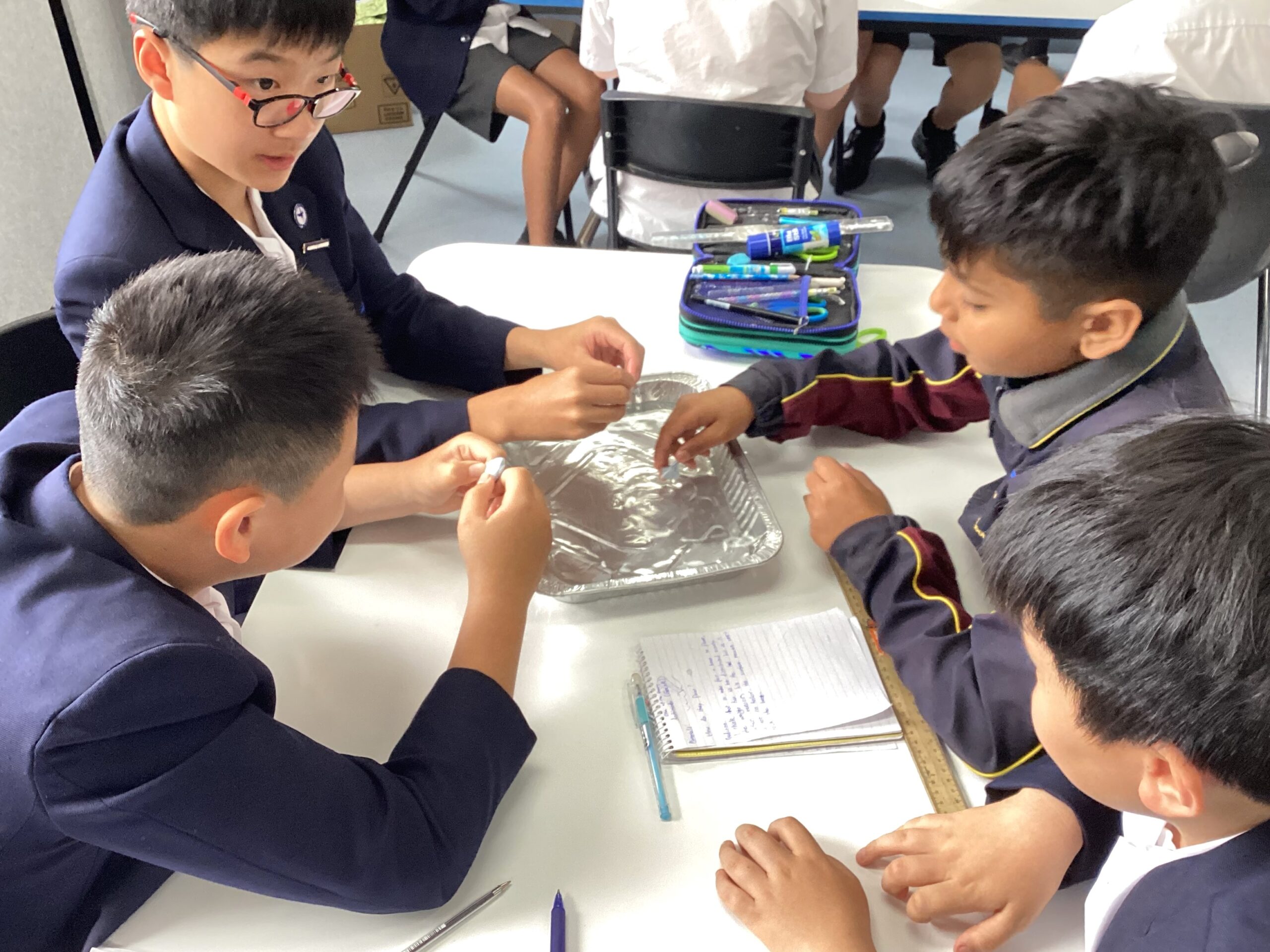
To bring Archimedes’ ideas to life, students put the theory to the test with a hands-on Blu Tack experiment. Starting with the same material, they investigated how changing its shape could determine whether it floated or sank. By transforming a solid ball of Blu Tack into a boat-like shape, students observed how the new shape displaced more water and was able to support its weight.
The experiment prompted plenty of thoughtful discussion about why objects float, how shape affects displacement and how discoveries made thousands of years ago continue to influence our understanding of the world today.
It was also a wonderful reminder that we often stand on the shoulders of giants, building on the curiosity, observations and experiments of those who came before us. Archimedes’ willingness to question, investigate and experiment helped lay foundations for scientific thinking that remain relevant today.
“Blu Tack, like boats and aircraft, can float when it displaces enough water compared to its weight. Shape plays an important role. For example, spreading out in a swimming pool makes you more likely to float than curling into a ball, as your body displaces more water.” – Nina, 6B
“A boat floats because it usually has a space where it stores air. By doing this, the density changes, allowing the boat to float. In our experiment, the Blu Tack floated because we reshaped it to displace more water. It’s all about shape! I observed that the Blu Tack floated better when shaped like a boat, rather than a random shape like a square or circle.” – Kingsley, 6A
Through these combined Science and Humanities experiences, Year 6 students are discovering that curiosity, persistence and a willingness to challenge existing ideas can lead to discoveries that make a positive difference to our world.